Sensitivity and Calibration
6.1 Local Sensitivity 6.2 Model Calibration
As explained in the technical manual (Rios et al., 2011), the nitrate concentration is evaluated in ArcNLET using the two-dimensional, steady-state version of the solution of Domenico (1987) for the advection-dispersion equation. It is shown in equation (6‑1).
|
|
|---|---|
|
( 6‑1) |
|
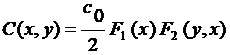
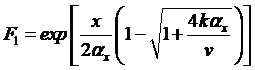
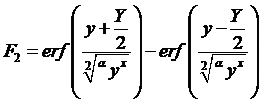
where C [ML-3] is simulated nitrate concentration at location (x,y), αx [L] is longitudinal dispersivity, αy [L] is horizontal transverse dispersivity, [L]; k [T-1] is the first order decay coefficient, v [LT−1] is groundwater seepage velocity in the longitudinal direction, Y [L] is the width of the source plane respectively, and C0 [ML-3] is the nitrate concentration at the source plane. The seepage velocity is evaluated in the groundwater flow model that uses hydraulic conductivity, porosity, and a smoothing factor to process DEM to obtain the shape of the water table. ArcNLET has seven parameters: the smoothing factor, hydraulic conductivity, porosity, longitudinal dispersivity, horizontal transverse dispersivity, first-order decay coefficient, and source nitrate concentration. Both local and global sensitivity analyses are performed to identify the parameters most critical to the simulated nitrate concentration. The local sensitivity reveals the relationships between the simulated nitrate concentration and individual parameters. The global sensitivity is more robust than the local sensitivity since it considers interactions between the parameters and the nonlinearity of the concentration concerning the parameters. For simplicity, the sensitivity to the smoothing factor, hydraulic conductivity, and porosity is not evaluated. Instead, the sensitivity to seepage velocity is calculated as a surrogate.
Local Sensitivity
The local sensitivity is the derivative of the nitrate concentration to an individual parameter calculated for specific nominal parameter values. In this study, the nominal parameter values and their sources are as follows:
Seepage velocity: v = 0.2 m/d. This velocity is the representative value of the domains of interest.
Source plane concentration: C0 = 40 mg/L. This value is from a review article by McCray et al. (2005).
First-order decay coefficient: k = 0.008/day. This value is from a review article by McCray et al. (2005). Longitudinal dispersivity: αx = 2.113 m. This value is from the work of Davis (2000) at a vicinity site in Jacksonville, FL.
Horizontal transverse dispersivity: αx = 0.234 m. This value is from the work of Davis (2000) at a vicinity site in Jacksonville, FL.
Source plane length: Y = 6m. This value is the typical length of the drain field of a septic system.
X coordinate: X = 30m. This coordinate value is arbitrarily selected for the demonstration.
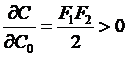
By the analytical solution (6‑2), analytical expressions of the local sensitivity can be easily derived. The local sensitivity to the source plane nitrate concentration is shown in (6‑2).
|
 (6‑2)
(6‑2)It suggests a positive linear relationship between the simulated nitrate concentrations and the source plane nitrate concentration. This relationship is illustrated in Figure 6‑1 for two y values, the nominal parameters’ values listed above. The equation and figure show that the increase in source plane nitrate concentration increases the simulated concentration within the plume. The increase is prominent at locations closer to the plume center line (y=0m).
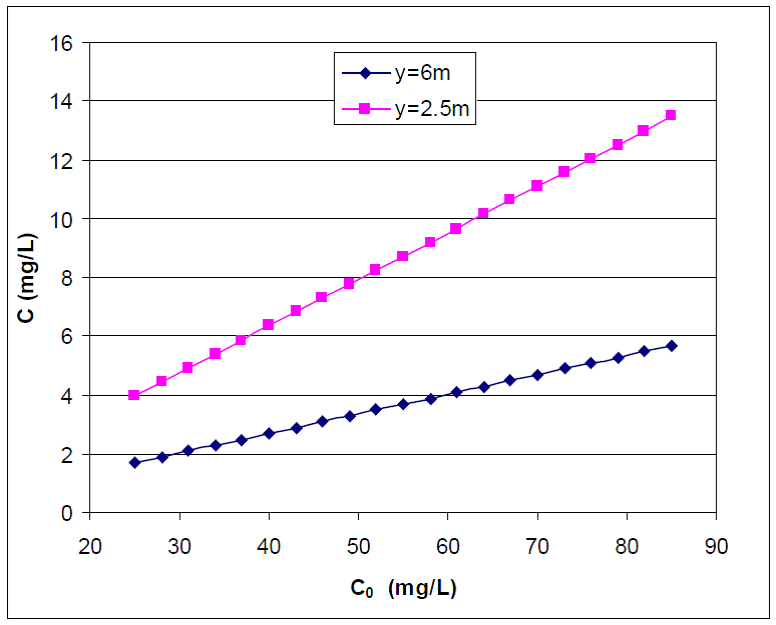
For illustration, the plot shows the measured and simulated nitrate concentrations at two locations of y.
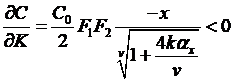
The local sensitivity to the first-order decay coefficient is shown in (6‑3).
|
 (6‑3)
(6‑3)It suggests a negative relationship with the simulated concentration, as demonstrated in Figure 6‑2. In other words, increasing the first-order decay coefficient decreases the simulated concentration within the plume. The decrease is faster at locations closer to the plume center line (y=0m).
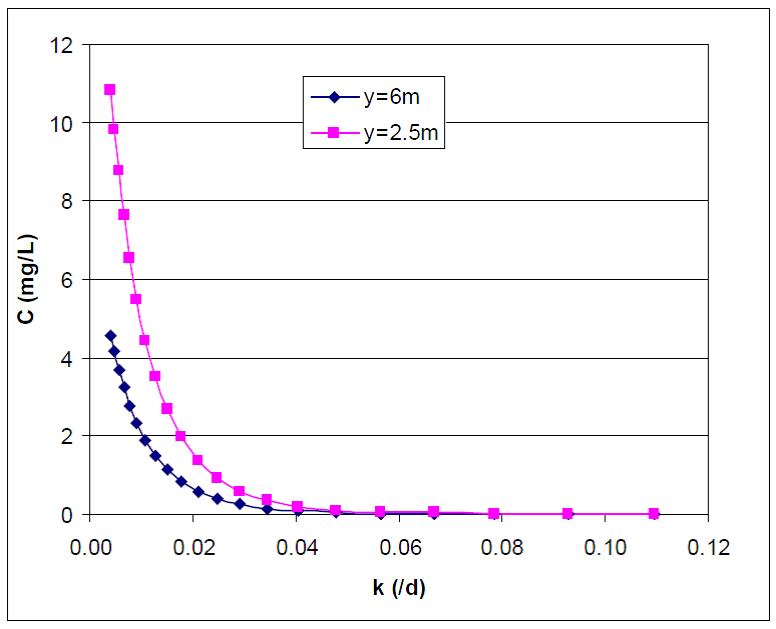
The plot illustrates the relationship between the first-order decay coefficient and simulated nitrate concentration at two locations of y.
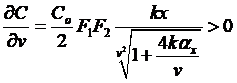
The analytical expressions of sensitivity to the seepage velocity are shown in (6‑4).
|
 (6‑4)
(6‑4)The expression suggests a positive relationship with simulated concentration. Figure 6‑3 shows that the velocity increase is associated with an increased simulated concentration within the plume. The increase is greater at locations closer to the plume center line (y=0m).
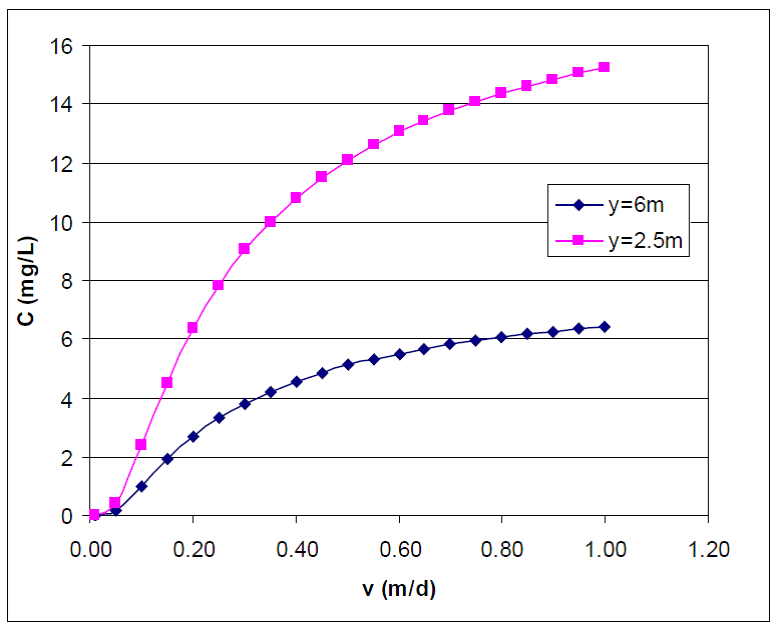
For illustration, the plot shows the average flow velocity and simulated nitrate concentration at two locations of y.
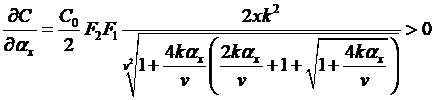
The analytical expression of sensitivity to the longitudinal dispersivity is shown in (6‑5).
|
 (6‑5)
(6‑5)Indicates that increasing the longitudinal dispersivity causes an increase in the simulated concentration within the plume. Figure 6‑4 shows that the increase is more rapid at locations closer to the plume center line (y=0m).
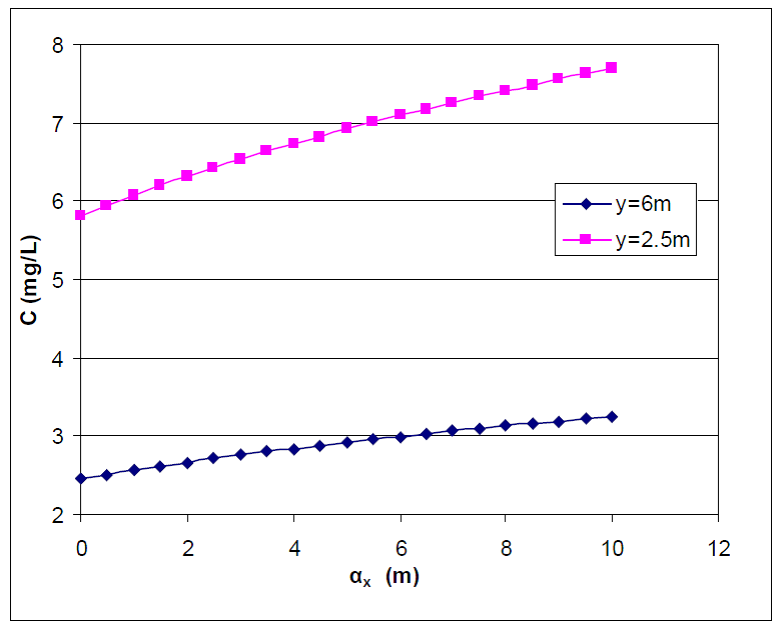
For illustration, the plot shows the relationship between longitudinal dispersivity and simulated nitrate concentration at two locations of y.
The sensitivity to the horizontal transverse dispersivity is more complicated than longitudinal. The analytical expression is shown in (6‑6).
|
|
|---|---|
|
(6‑6) |
|


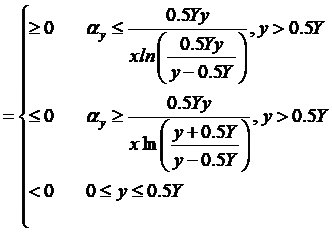
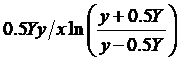
The equation above shows that the relationship between the simulated nitrate concentration and the parameter depends on the length of the source plane (Y) and the location (x and y) in the plume. In addition, there is a threshold value shown in (6‑7).
|
 (6‑7)
(6‑7)When the horizontal transverse dispersivity is smaller than the threshold value, the relationship is positive but becomes negative when the threshold value is exceeded. This is demonstrated in Figure 6‑5.
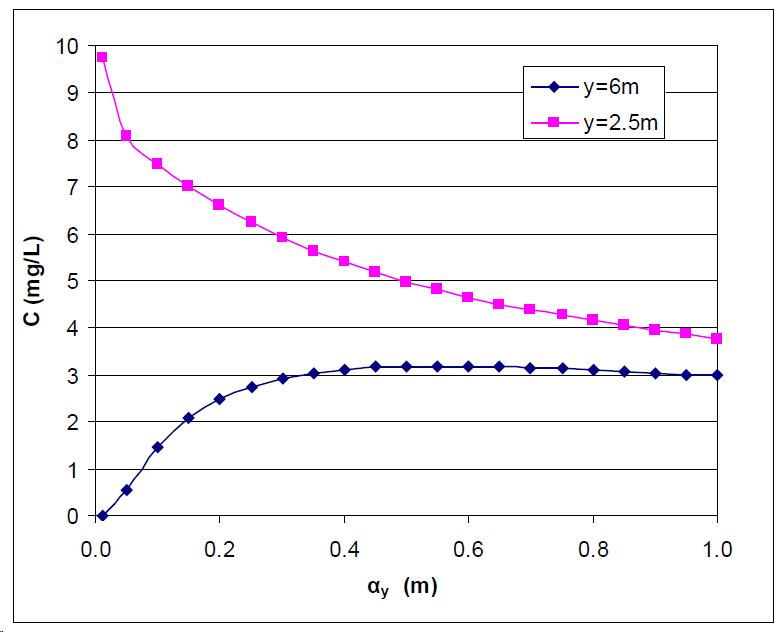
Figure 6‑5: Relationship between horizontal dispersivity and concentration.
For illustration, the plot shows the relationship between horizontal transverse dispersivity and simulated nitrate concentration at two locations of y.
In summary, the local sensitivity analyses indicate that the simulated concentration is an increasing function of the source plane concentration, flow velocity, and longitude dispersivity but a decreasing function of the decay coefficient. The relationship with the horizontal transverse dispersivity depends on the parameter value and the locations where concentration is evaluated. These results are physically reasonable. For example, a large value of the decay coefficient means more denitrification and, thus, small values of simulated concentration. The relationships serve as guidelines for adjusting model parameters by trial and error to match field observations of nitrate concentration during the model calibration.
Table 6‑1: The critical parameters at selected locations within the nitrate plume.
x (m) y (m) |
0. 0001 |
5 |
10 |
15 |
20 |
30 |
40 |
50 |
|---|---|---|---|---|---|---|---|---|
0 |
C 0, v |
k, v |
k ,v |
k, v |
k, v |
k, v |
k, v |
k, v |
1 |
C 0, v |
k, v |
k ,v |
k, v |
k, v |
k, v |
k, v |
k, v |
2 |
C 0, v |
k, v |
k ,v |
k, v |
k, v |
k, v |
k, v |
k, v |
3 |
C 0, v |
k, v |
k ,v |
k, v |
k, v |
k, v |
k, v |
k, v |
4 |
/ |
k, v |
k ,v |
k, v |
k, v |
k, v |
k, v |
k, v |
6 |
/ |
k, v |
k ,v |
k, v |
k, v |
k, v |
k, v |
k, v |
8 |
/ |
k, α y |
k ,v |
k, v |
k, v |
k, v |
k, v |
k, v |
10 |
/ |
α y , k |
k, α y |
k, α y |
k, v |
k, v |
k, v |
k, v |
12 |
/ |
α y , k |
k, α y |
k, α y |
k, α y |
k, v |
k, v |
k, v |
Model Calibration
Generally speaking, model calibration matches the simulated nitrate concentration to the observed ones by adjusting the model parameters. Model calibration in this study is necessary due to the lack of characterization data for describing the hydrogeologic conditions of the modeling domains. For example, no other parameter measure is available except for the hydraulic conductivity and porosity downloaded from the SSURGO database. The only site-specific measurements are the particulate organic carbon (POC) content collected from the Eggleston Heights and Julington Creek neighborhoods at the top 1.5 m of the saturated zone. The data shows that the average POC content is 0.35% and 1.08% in the Eggleston Heights and Julington Creek neighborhoods. Anderson (1998) states that the denitrification rate is positively correlated with POC content. The higher POC content in the Julington Creek area suggests a higher denitrification rate. This data is taken as prior information for the model calibration.
The trial-and-error model calibration starts from the Eggleston Height neighborhood by evaluating nitrate concentration in the modeling domains using the smoothing factor of 60, heterogeneous hydraulic conductivity and porosity downloaded from the SSURGO database, longitude dispersivity αx of 2.113 m (Davis 2000), αy of 0.234 m (Davis 2000), C0 of 40 mg/L (McCray et al. 2005), and first-order decay coefficient k of 0.025/d (McCray et al. 2005). The most sensitive parameters identified in the sensitivity analyses are subsequently adjusted to obtain an improved fit between the simulated and observed nitrate concentration. The sensitivity to seepage velocity is reflected by adjusting hydraulic conductivity because it plays the most critical role in determining the velocity’s magnitude.
The detailed procedure of model calibration within ArcNLET is as follows:
Calibrate the flow model by adjusting the smoothing factor and using the mean hydraulic head observations at the monitoring wells as the calibrated targets. Since ArcNLET does not simulate hydraulic head but hydraulic gradient, the goal of adjusting the smoothing factor is to obtain a linear relationship between the smoothed DEM (which is an intermediate output layer of the Groundwater Flow Module, described in detail in the user’s manual) and the calibration targets values at the observation wells. The slope of the linear relationship must be close to 1.0 so that the shape of the smoothed DEM mimics the shape of the water table. Hydraulic conductivity is not calibrated in this step unless observations of groundwater velocity are available.
Calibrate the transport model using trial and error by adjusting the first-order decay coefficient, hydraulic conductivity, dispersivities, and source concentration. The calibration goal is to match the simulated nitrate concentration to the mean observations at the monitoring wells. Due to the complex nature of nitrate transport and the simplicity of the model behind ArcNLET, it is not likely that the match is achieved at all the wells. A reasonable expectation is that the simulated nitrate concentration falls in the inter-quartile range or maximum and minimum observations at each well. Given that multiple septic systems can impact nitrate concentration at a monitoring well, the global sensitivity analysis results are essential guidelines to adjust different parameters for different septic systems. Using homogenous values of the first-order decay coefficient, dispersivities, and source concentration is recommended because they may be considered representative values of the modeling domain. Adjusting the hydraulic conductivity within the high and low values given in the soil survey data is recommended.
Based on our experience, the model calibration for the flow model is relatively easy. In contrast, the calibration of the transport model may be time-consuming and require a solid understanding of the nitrate transport from the hydrogeologic point of view.